
At We Conquer Together, we recognize that healing from an eating disorder involves far more than just addressing food and nutrition—it also includes reclaiming a positive relationship with your body. That’s why we’re proud to offer Yoga & Joyful Movement as a supportive component of our care in Orange County, California. When you are receiving care through our inpatient treatment, these movement-based practices are integrated into our broader eating disorder treatment center offerings.
Our approach to yoga is inclusive, trauma-informed, and grounded in the latest research on mind-body healing. Our certified yoga instructors and clinicians understand the unique needs of individuals struggling with anorexia nervosa, bulimia, or binge eating disorder, and we tailor movement sessions to support body reconnection, emotion regulation, and long-term well-being. Whether you’re new to yoga or returning to it after time away, we offer a gentle, welcoming space where movement becomes an act of self-compassion, not punishment.
Yoga & Joyful Movement refers to intentional, body-connected activity that fosters internal awareness, body image healing, and emotional balance. Unlike rigorous or appearance-focused workouts, this approach prioritizes the mind-body connection, interoceptive awareness, and freedom from external judgment. Rooted in yoga practice but adaptable across all bodies and experience levels, joyful movement is about cultivating self-acceptance, not achieving a specific aesthetic.
Yoga interventions often include breathwork, asana (postures), guided relaxation, and meditative movement. But joyful movement might also take the form of walking, dancing, or stretching—any physical activity that brings a sense of pleasure and grounding. Within the context of eating disorder recovery, this shift in perspective helps reduce compulsive behaviors, challenges disordered eating beliefs about exercise, and supports mental health through connection, presence, and gentle activity.
Emerging current research supports the role of yoga therapy in the treatment of eating disorders, with findings indicating improvements in body awareness, self-esteem, and reductions in eating disorder symptoms. For example, a randomized controlled trial published in J Eat Disord found that yoga led to significant improvements in emotion regulation and reduced body dissatisfaction among participants in recovery from bulimia and anorexia. Researchers like Cook-Cottone, Neumark-Sztainer, and others have explored how the use of yoga may reduce internalized appearance ideals and support intuitive movement.
In another DOI-referenced review of yoga and eating disorder treatment, yoga was shown to increase validation of bodily sensations and reduce avoidance behaviors. This may be due to yoga’s calming influence on the nervous system, which supports trauma healing and emotional integration. Additionally, the interoceptive focus in many yoga classes—being attuned to how the body feels from the inside—can help clients shift their attention from how they look to how they feel.

In the context of eating disorder treatment, exercise is often misunderstood or misused. Many individuals with disordered eating have used exercise as a form of control or punishment, especially those struggling with anorexia nervosa or bulimia. At We Conquer Together, Yoga & Joyful Movement offer an alternative—a space where movement is about care, not correction.
Key differences between joyful movement and traditional exercise include:
This modality invites individuals to redefine their relationship with exercise and the body. The goal is to build trust, not to reshape or sculpt. It provides an opportunity to reconnect with joy and spontaneity through movement, promoting both physical and psychological healing.
Located in the serene, scenic surroundings of Orange County, California, We Conquer Together is uniquely positioned to offer movement practices in a restorative environment. Whether it’s gentle movement during an ocean-view walk, peaceful yoga in our serene backyard with a koi pond, or grounding practices in our warm and welcoming residential setting, our Orange County location offers a beautiful and restorative environment to reconnect with your body in a safe and natural way.This region also benefits from a strong network of holistic healthcare providers, wellness communities, and trauma-informed instructors—making it a supportive ecosystem for yoga-based interventions. Many of our clients come to us from surrounding cities in Southern California, including those who haven’t felt safe or seen in more traditional healthcare settings. At We Conquer Together, we believe that the practice of yoga can be a bridge between emotional healing and embodied living—and Orange County provides the space to make that connection flourish.
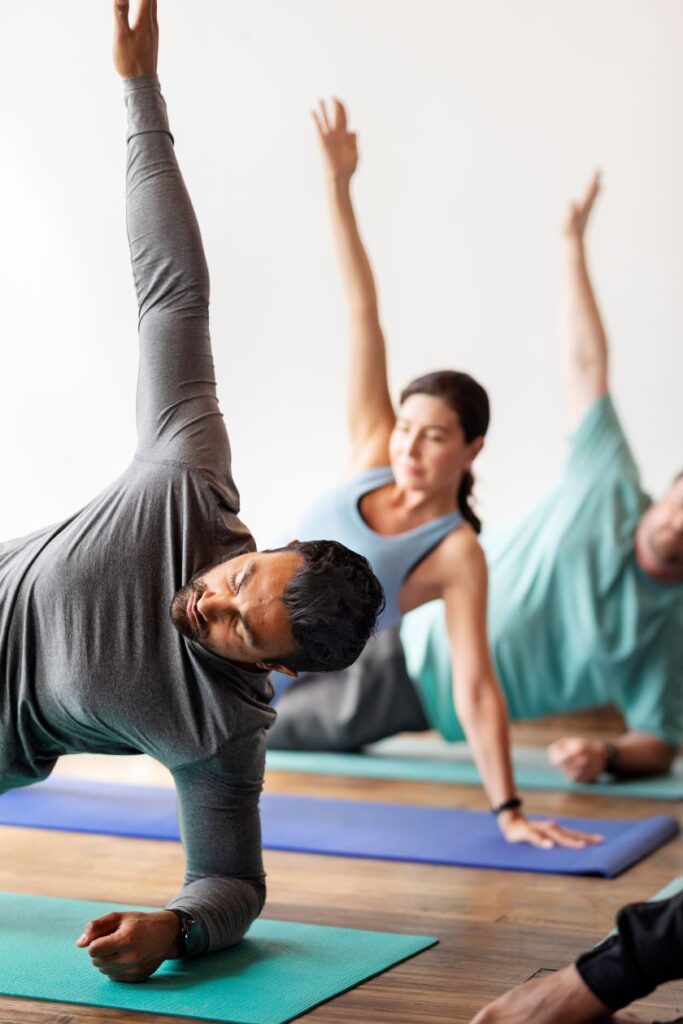
Yoga & Joyful Movement are appropriate for a wide range of individuals seeking healing in body, mind, and spirit. At We Conquer Together, our offerings are especially helpful for those who:
Joyful movement can be integrated into your treatment in a way that feels empowering and non-triggering.
Many clients come to us having lost connection to their bodies—either through years of dieting, trauma, or negative body image messaging. Yoga becomes a slow but powerful invitation to begin again. Through asana, breath, and meditation, we rebuild that connection from the inside out, always at a pace that respects each person’s story.
This path toward body trust isn’t about perfection or performance—it’s about learning to listen again. It’s about honoring your body’s boundaries, celebrating small victories, and rediscovering what it means to move with freedom, not fear. Over time, we see clients begin to smile during movement, choose rest over punishment, and even develop their own self-care rituals that include gentle stretching, walking, or simply breathing.

At We Conquer Together, we are proud to offer Yoga & Joyful Movement as a meaningful, research-informed element of our care in Orange County, California. Our experienced yoga teachers, therapists, and clinical staff work collaboratively to offer trauma-informed movement programming for all clients in our residential treatment program.
Our approach is rooted in the belief that every body deserves kindness, presence, and healing. Whether you’re looking to enhance your current treatment program or are just beginning your journey, our yoga offerings can support you in building self-esteem, body trust, and long-term well-being.
If you or a loved one is navigating eating disorder symptoms and looking for a holistic, body-inclusive approach, reach out to our team today. Let’s move toward healing—together.
We Conquer Together
We firmly believe that the internet should be available and accessible to anyone, and are committed to providing a website that is accessible to the widest possible audience, regardless of circumstance and ability.
To fulfill this, we aim to adhere as strictly as possible to the World Wide Web Consortium’s (W3C) Web Content Accessibility Guidelines 2.1 (WCAG 2.1) at the AA level. These guidelines explain how to make web content accessible to people with a wide array of disabilities. Complying with those guidelines helps us ensure that the website is accessible to all people: blind people, people with motor impairments, visual impairment, cognitive disabilities, and more.
This website utilizes various technologies that are meant to make it as accessible as possible at all times. We utilize an accessibility interface that allows persons with specific disabilities to adjust the website’s UI (user interface) and design it to their personal needs.
Additionally, the website utilizes an AI-based application that runs in the background and optimizes its accessibility level constantly. This application remediates the website’s HTML, adapts Its functionality and behavior for screen-readers used by the blind users, and for keyboard functions used by individuals with motor impairments.
If you’ve found a malfunction or have ideas for improvement, we’ll be happy to hear from you. You can reach out to the website’s operators by using the following email
Our website implements the ARIA attributes (Accessible Rich Internet Applications) technique, alongside various different behavioral changes, to ensure blind users visiting with screen-readers are able to read, comprehend, and enjoy the website’s functions. As soon as a user with a screen-reader enters your site, they immediately receive a prompt to enter the Screen-Reader Profile so they can browse and operate your site effectively. Here’s how our website covers some of the most important screen-reader requirements, alongside console screenshots of code examples:
Screen-reader optimization: we run a background process that learns the website’s components from top to bottom, to ensure ongoing compliance even when updating the website. In this process, we provide screen-readers with meaningful data using the ARIA set of attributes. For example, we provide accurate form labels; descriptions for actionable icons (social media icons, search icons, cart icons, etc.); validation guidance for form inputs; element roles such as buttons, menus, modal dialogues (popups), and others. Additionally, the background process scans all the website’s images and provides an accurate and meaningful image-object-recognition-based description as an ALT (alternate text) tag for images that are not described. It will also extract texts that are embedded within the image, using an OCR (optical character recognition) technology. To turn on screen-reader adjustments at any time, users need only to press the Alt+1 keyboard combination. Screen-reader users also get automatic announcements to turn the Screen-reader mode on as soon as they enter the website.
These adjustments are compatible with all popular screen readers, including JAWS and NVDA.
Keyboard navigation optimization: The background process also adjusts the website’s HTML, and adds various behaviors using JavaScript code to make the website operable by the keyboard. This includes the ability to navigate the website using the Tab and Shift+Tab keys, operate dropdowns with the arrow keys, close them with Esc, trigger buttons and links using the Enter key, navigate between radio and checkbox elements using the arrow keys, and fill them in with the Spacebar or Enter key.Additionally, keyboard users will find quick-navigation and content-skip menus, available at any time by clicking Alt+1, or as the first elements of the site while navigating with the keyboard. The background process also handles triggered popups by moving the keyboard focus towards them as soon as they appear, and not allow the focus drift outside it.
Users can also use shortcuts such as “M” (menus), “H” (headings), “F” (forms), “B” (buttons), and “G” (graphics) to jump to specific elements.
We aim to support the widest array of browsers and assistive technologies as possible, so our users can choose the best fitting tools for them, with as few limitations as possible. Therefore, we have worked very hard to be able to support all major systems that comprise over 95% of the user market share including Google Chrome, Mozilla Firefox, Apple Safari, Opera and Microsoft Edge, JAWS and NVDA (screen readers).
Despite our very best efforts to allow anybody to adjust the website to their needs. There may still be pages or sections that are not fully accessible, are in the process of becoming accessible, or are lacking an adequate technological solution to make them accessible. Still, we are continually improving our accessibility, adding, updating and improving its options and features, and developing and adopting new technologies. All this is meant to reach the optimal level of accessibility, following technological advancements. For any assistance, please reach out to